th5220d1029 installer manual
Honeywell TH5220D1029 Installer Manual: A Comprehensive Guide
This detailed manual provides comprehensive instructions for installing and configuring the Honeywell TH5220D1029 thermostat,
a non-programmable digital model within the FocusPRO 5000 series, ensuring optimal HVAC system performance.
The Honeywell TH5220D1029 is a user-friendly, non-programmable digital thermostat designed for straightforward temperature control within residential environments. As part of the FocusPRO 5000 series, it offers reliable operation and easy installation, making it suitable for both DIY enthusiasts and professional HVAC technicians.
This model specifically supports systems with two heating stages and two cooling stages, providing adaptable comfort throughout the year. It operates on standard 24 VAC power, and is also compatible with 750 mV heating systems, offering flexibility in various installations. The thermostat features a clear display and intuitive controls, simplifying temperature adjustments and fan settings.
This guide will walk you through the entire installation process, from safety precautions and tool requirements to wiring diagrams and system configuration, ensuring a seamless integration with your existing HVAC setup.
Understanding the FocusPRO 5000 Series
Honeywell’s FocusPRO 5000 series represents a commitment to simple, reliable, and affordable thermostat technology. This series is designed to provide essential climate control without the complexities of advanced programmable features, making it ideal for users seeking ease of use. The TH5220D1029 is a key model within this series, offering a balance of functionality and straightforward operation.
The FocusPRO 5000 line prioritizes compatibility with a wide range of HVAC systems, including those utilizing 24 VAC and 750 mV power sources. Each thermostat within the series shares a similar user interface and installation process, streamlining the experience for installers.
Key benefits include clear display readability, intuitive button controls, and robust performance. The series aims to deliver consistent temperature management, enhancing comfort and energy efficiency in residential settings.
Key Features of the TH5220D Model
The Honeywell TH5220D1029 stands out as a non-programmable digital thermostat designed for 2 heat/2 cool systems, offering dependable temperature regulation. Its primary feature is simplicity – a user-friendly interface with easily adjustable temperature settings and fan control options (Auto and On). The clear display ensures effortless readability of current and set temperatures.
This model supports both 24 VAC single-stage and multi-stage heating and cooling systems, as well as 750 mV heating systems, providing broad compatibility.
Furthermore, the TH5220D incorporates features like Auto Changeover, intelligently switching between heating and cooling based on indoor temperature, and compressor protection to safeguard the HVAC system. It’s a robust and reliable solution for consistent comfort.
Installation Process
Proper installation of the TH5220D1029 requires careful adherence to safety precautions, utilizing the correct tools, and accurately following the wiring diagram for optimal performance.
Safety Precautions Before Installation
Prior to commencing the installation of your Honeywell TH5220D1029 thermostat, it is absolutely crucial to prioritize safety. Always disconnect power to the HVAC system at the breaker box or fuse panel to prevent electrical shock. Confirm the power is off with a reliable voltage tester.
Exercise caution when handling wiring, ensuring no bare wires are exposed. If you are uncomfortable working with electrical connections, consult a qualified HVAC technician. Incorrect wiring can damage the thermostat or the HVAC system, and potentially create a fire hazard.
Read and understand all instructions in this manual before beginning. Wear appropriate safety glasses to protect your eyes. Keep this manual readily available for future reference. Do not install the thermostat in a damp or humid location. Follow all local electrical codes during the installation process.
Tools Required for Installation

Successfully installing your Honeywell TH5220D1029 thermostat requires a few essential tools. A small flathead screwdriver is necessary for terminal connections and adjustments. A Phillips head screwdriver will be needed for mounting the thermostat base to the wall.
A wire stripper/cutter is crucial for preparing the thermostat wires for secure connections. A voltage tester is vital to confirm power is disconnected before working with wiring – safety first! A level ensures the thermostat is mounted straight for accurate readings and a professional appearance.
Pencil for marking screw locations. Drill with appropriate drill bits for wall mounting (if needed). Wire labels are highly recommended to clearly identify each wire before disconnection, simplifying reconnection. Safety glasses are always a good practice.
Wiring Diagram and Terminal Identification
Proper wiring is critical for the TH5220D1029’s functionality. The thermostat supports 24 VAC systems and 750 mV heating systems. Key terminals include R (24 VAC power), C (common), W (heat), Y (cool), G (fan). For two-stage systems, you’ll find W2 and Y2 terminals for the second stages of heating and cooling.
Carefully label each wire before disconnecting from the old thermostat. A typical wiring configuration uses color-coded wires: Red (R/RC), White (W/W2), Yellow (Y/Y2), Green (G), and Blue (C).
Refer to the detailed wiring diagram included in this manual or on the thermostat’s backplate. Incorrect wiring can damage your HVAC system. If unsure, consult a qualified HVAC technician. Ensure wires are securely connected to the appropriate terminals.
Mounting the Thermostat Base
Before mounting, ensure power is OFF at the breaker to prevent electrical shock. Remove the existing thermostat baseplate, carefully noting wire connections. Use the provided mounting screws and anchors to secure the new TH5220D1029 baseplate to the wall. Ensure the baseplate is level for accurate temperature sensing and a clean appearance.
Thread the wires through the opening in the baseplate. Gently push any excess wire back into the wall cavity. Connect the wires to the corresponding terminals, verifying a secure connection. Snap the thermostat body onto the mounted baseplate until it clicks into place.
Double-check all connections before restoring power. A properly mounted baseplate is crucial for stable operation and accurate temperature control.

System Compatibility and Configuration
The TH5220D1029 supports 24 VAC single and multi-stage heating/cooling systems, and also 750 mV heating systems, requiring careful configuration for optimal performance.
Supported HVAC System Types (2 Heat/2 Cool)
The Honeywell TH5220D1029 thermostat is specifically designed to accommodate HVAC systems with up to two stages of heating and two stages of cooling. This versatility makes it suitable for a wide range of residential applications. It effectively manages conventional systems, heat pumps, and dual-fuel configurations.
Understanding your system type is crucial for correct installation and configuration. The thermostat can handle systems with gas, oil, or electric heat, alongside central air conditioning or heat pump cooling. Proper wiring and settings ensure seamless operation between the thermostat and your HVAC equipment.
For systems utilizing two heat sources, such as gas and electric, the thermostat can be configured to automatically switch between them based on outdoor temperature or energy costs. This feature maximizes efficiency and comfort. Always consult a qualified HVAC technician if you are unsure about your system’s configuration.
Voltage Requirements (24 VAC & 750 mV)
The Honeywell TH5220D1029 thermostat operates on standard low-voltage HVAC control circuits, supporting both 24 VAC (Volts Alternating Current) and 750 mV (millivolts) systems. The 24 VAC power is commonly used for conventional heating and cooling systems, providing reliable operation of relays and dampers.
For older or specialized heating systems, particularly those utilizing millivolt systems, the thermostat can directly interface with the generator output. This eliminates the need for additional transformers or power supplies.
It is critical to verify your HVAC system’s voltage before installation. Incorrect voltage application can damage the thermostat or the connected HVAC equipment. Always disconnect power to the system before making any wiring connections. If unsure, consult a qualified HVAC professional to ensure compatibility and safe installation.
Configuring for Single-Stage vs. Multi-Stage Systems
The Honeywell TH5220D1029 thermostat is adaptable to both single-stage and multi-stage heating and cooling systems, offering flexibility for various HVAC setups. Single-stage systems operate at a fixed capacity, while multi-stage systems offer varying levels of heating or cooling for improved comfort and efficiency.
During installation, the thermostat must be configured to match the system type; This is typically achieved through dip switch settings or menu options, depending on the specific model.
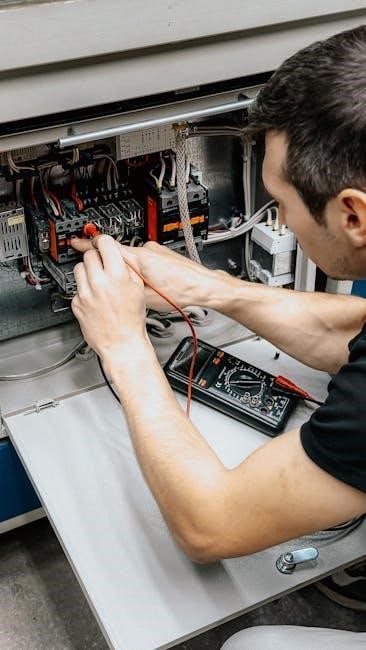
Proper configuration ensures accurate temperature control and optimal system performance. Incorrect settings can lead to short-cycling, inefficient operation, or failure to reach the desired temperature. Refer to the wiring diagram and configuration guide for detailed instructions on setting the thermostat for your specific HVAC system.
Operating the TH5220D1029
The Honeywell TH5220D1029 features a user-friendly interface with intuitive buttons and a clear display, allowing for easy temperature adjustments and fan control options.
Understanding the Display and Buttons
The Honeywell TH5220D1029 thermostat boasts a clear, easy-to-read digital display that prominently shows the current room temperature and the setpoint temperature. The display also indicates the current system mode – heating, cooling, or auto – and fan status (auto or on).
Button functionality is straightforward: typically, up and down arrow buttons adjust the setpoint temperature, while a ‘Mode’ button cycles through heating, cooling, and off settings. A ‘Fan’ button toggles between automatic and continuous fan operation.
The display may also include indicators for low battery levels or system errors, providing crucial information for troubleshooting. Familiarizing yourself with these display elements and button functions is key to effectively operating your thermostat and maintaining a comfortable indoor environment. The non-programmable design prioritizes simplicity and ease of use for all users.
Setting the Temperature
Adjusting the desired room temperature on the Honeywell TH5220D1029 is a simple process. Utilize the up and down arrow buttons located on the thermostat’s faceplate. Pressing the ‘up’ arrow increases the setpoint temperature, while the ‘down’ arrow decreases it. The current setpoint temperature will be clearly displayed on the digital screen.
The thermostat responds immediately to these adjustments, initiating the heating or cooling cycle as needed to reach the selected temperature. Remember that the displayed temperature is the setpoint – the temperature the thermostat aims to maintain. Allow sufficient time for the system to respond and achieve the desired comfort level.
For optimal comfort and energy efficiency, start with a moderate temperature setting and adjust incrementally until you find your preferred level. The non-programmable nature means consistent temperature control is achieved manually.
Fan Control Options (Auto, On)
The Honeywell TH5220D1029 offers two distinct fan control settings: ‘Auto’ and ‘On’. Selecting ‘Auto’ is the typical operation mode, where the fan only runs during heating or cooling cycles. This conserves energy and ensures efficient air circulation when temperature adjustments are active.
Choosing the ‘On’ setting forces the fan to run continuously, regardless of whether the heating or cooling system is actively operating. This provides constant air circulation, which can be beneficial for evenly distributing temperature throughout the space and improving air quality.
To switch between these modes, use the designated ‘Fan’ button on the thermostat. The current fan setting will be indicated on the display. Consider your comfort preferences and air circulation needs when selecting the appropriate fan control option.
Advanced Features & Settings
The TH5220D1029 includes features like Auto Changeover and Compressor Protection, enhancing system efficiency and longevity. Battery replacement is also straightforward for continued operation.
Auto Changeover Functionality
The Auto Changeover feature is particularly useful in climates experiencing fluctuating temperatures throughout the day, where both heating and cooling may be required. When the thermostat is set to “Auto,” it intelligently switches between heating and cooling modes based on the measured indoor temperature, eliminating the need for manual adjustments.
For optimal performance with Auto Changeover, Honeywell recommends maintaining a temperature difference of at least three degrees Fahrenheit between the heating and cooling setpoints. This prevents rapid cycling between modes, ensuring consistent comfort and efficient energy usage. The thermostat continuously monitors the indoor temperature and activates either the heating or cooling system as needed to maintain the desired temperature range.
This automated process simplifies temperature control and provides a convenient solution for homeowners in regions with variable weather conditions, maximizing comfort and minimizing energy waste.
Compressor Protection Settings
The Honeywell TH5220D1029 thermostat incorporates compressor protection features designed to extend the lifespan of the air conditioning compressor. These settings prevent short-cycling, a common cause of compressor failure, by ensuring a minimum “off” time between cooling cycles. Short-cycling occurs when the compressor repeatedly turns on and off in quick succession, placing undue stress on its components.
The compressor protection delay, typically adjustable during installation or configuration, dictates the minimum time the compressor must remain off before it can be restarted. This delay allows the refrigerant pressure to equalize and prevents liquid refrigerant from returning to the compressor, which can cause damage.
Properly configuring these settings is crucial for maintaining the reliability and efficiency of the cooling system, safeguarding against costly repairs and ensuring long-term performance.
Battery Replacement Procedure
The Honeywell TH5220D1029 thermostat utilizes batteries to maintain settings during power outages and to operate certain functions. While the thermostat will continue to control the HVAC system even with depleted batteries, losing power will result in the loss of programmed settings, requiring re-configuration.
To replace the batteries, first, locate the battery compartment, typically accessed by removing the thermostat faceplate. Gently detach the faceplate, being careful not to damage any wiring. Remove the old batteries, noting their polarity (+ and -).
Insert new alkaline batteries of the correct size (usually AA) ensuring correct polarity alignment. Reattach the faceplate securely. It’s recommended to replace batteries annually or when the low battery indicator appears on the display, ensuring uninterrupted operation and preserving your preferred settings.

Troubleshooting Common Issues
This section details solutions for frequent problems, including no power, inaccurate temperature readings, and unresponsive system commands, ensuring reliable thermostat functionality.
Thermostat Not Powering On
If the Honeywell TH5220D1029 thermostat fails to power on, several potential causes should be investigated systematically. First, verify the system power supply at the furnace or air handler, ensuring the breaker hasn’t tripped and the power is consistently available.
Next, carefully inspect the thermostat wiring, confirming all connections are secure and correctly placed on the terminals, referencing the wiring diagram. A loose wire can easily interrupt the power supply. Check the batteries, even if the thermostat is wired for 24VAC, as batteries often provide backup power and are crucial for initial startup.
Ensure the ‘C’ wire (common wire) is properly connected, as this is essential for providing continuous power. If a ‘C’ wire isn’t present, a ‘C’ wire adapter might be necessary. Finally, if the issue persists, consult a qualified HVAC technician to diagnose potential problems with the HVAC system’s control board or transformer.
Incorrect Temperature Readings
If the Honeywell TH5220D1029 displays inaccurate temperature readings, begin by verifying the thermostat’s location isn’t affected by drafts, direct sunlight, or heat-generating appliances. These external factors can significantly skew temperature sensing. Ensure the thermostat is level and securely mounted to the wall, as an uneven position can impact accuracy.
Check for obstructions near the thermostat that might impede airflow around the internal temperature sensor. Compare the thermostat’s reading with a known accurate thermometer placed nearby to quantify the discrepancy. If the difference is substantial, consider recalibrating the thermostat, if such a feature is available (refer to advanced settings).
Inspect the wiring for any loose connections or corrosion, as these can sometimes cause erratic readings. If the problem continues, a faulty temperature sensor within the thermostat may require replacement by a qualified HVAC technician.
System Not Responding to Thermostat Commands
When the Honeywell TH5220D1029 fails to control the HVAC system, the first step is to verify the system’s power supply at the furnace or air handler. Check the circuit breaker or fuse dedicated to the HVAC system to ensure it hasn’t tripped or blown. Confirm the thermostat has sufficient battery power or is receiving 24 VAC power from the HVAC system.
Inspect the wiring connections at both the thermostat and the HVAC unit, looking for loose wires, corrosion, or incorrect connections. Double-check the wiring diagram to ensure all wires are connected to the correct terminals. If the wiring appears correct, the issue might lie within the HVAC system itself, requiring professional diagnosis.
Consider a reset of the thermostat, if applicable, following the manufacturer’s instructions.









Leave a Comment